|
|
| Places revisited since my overland journey from England to Australia |
By Steven Abrams |
|---|
|
|
Tourism to Goa has grown considerably in the 80's and 90's, and as the more well heeled and older tourists started to flock in to the new hotels that were being built, so the backpackers became less and less. Charter flight and package tours started to become popular in the 90's and with the coming of package tours I decided it was time to visit the place again. At first I was worried about returning to a place that I remember as being so beautiful and unspoiled and for this reason I put off returning for a few years. But in 1997 curiosity got the better of me and I finally plucked up the courage to make the long journey back to the Sub-Continent. All the top hotels are to the South of Panjim and at first I planned to go to one of them, but if I did, it would really defeat the purpose of the journey. What I wanted was to re-visit the place I had stayed at in 1968. None of the brochures even mentioned the Royal hotel and I could only imagine that it had probably been bulldozed to make way for something newer. I decided to go back to Calangute and booked to stay in the Ronil Beach Resort hotel. Although it was advertised as being in Calangute just five minutes walk from the centre, when I tried to book it I was told that that was an error and the hotel was in fact in Baga. It was a good half-hour walk from the centre of Calangute, but with plenty of good cheap transport available. Despite this, I still booked the Ronil Beach Resort and as things turned out, I made an excellent decision.
Because of past memories of the bureaucratic Indian immigration service I decided to get out of the plane as quickly as possible, so that I could be near the front of the queue. It turned out to be a good move because as the line got longer it stretched up the stairs and out of the building leaving the people at the back of the queue to stand outside in the hot sun. Whatever else has changed in India, the speed of the immigration officers hasn't. When eventually it was my turn I was extremely surprised to find that the immigration desk was fully equipped with computers and passport scanners, so just why was it taking so long to process everybody. Once through immigration, the next delay was baggage reclaim. There are two baggage carousels in Dabolim and neither of them was working. Where the carousel passes through the usual door in the wall, the suitcases cases were being handed through to a waiting porter, who in turn would pass the case to one of many baggage handlers, who in turn would place the cases on the floor to await their owners. Because there was only a slow trickle of passengers coming through immigration, the floor soon filled up with unclaimed luggage, This meant that passengers who were still waiting for luggage had nowhere to stand except on the carousel. It is the only time I have ever seen the passengers on the carousel and the luggage waiting on the floor. Unfortunately it is very strictly prohibited to take photographs inside any airports in India, which was a shame because I could have won a prize for that one. The bus transferring us to our hotel in Calangute looked like it had been around when I was last here, and the porters went about passing all the luggage onto the roof, stacking it so precariously that we all thought it would fall off before we would arrive. After what seemed like an interminable wait, the driver eventually set out for the two and a half hour journey, during which time the horn must have been sounding for two hours of it. The first illusion to go was the empty roads. They are still fringed with palm trees, but the traffic is now quite heavy. The old ferries have almost all dissapeared, having been replaced by modern looking bridges. One of the bridges had a large hole in the middle. The gap either side was wide still enough for cars and taxis, but the bus couldn't fit and had to make a long diversion. The same journey by taxi is only one hour.
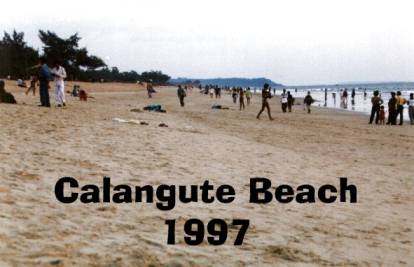
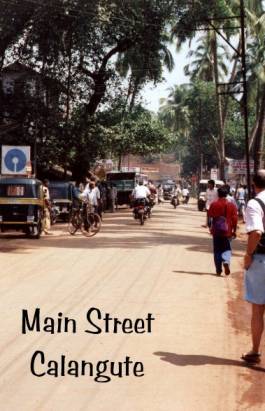
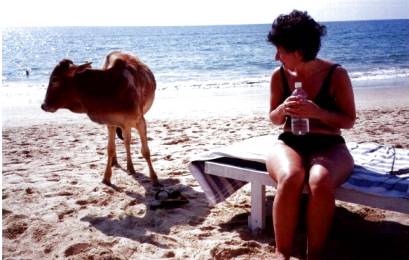
Not only had the town of Calangute changed, but so had the pronounciation of its name. No longer the Portuguese 'Calangutee', but now referred to by the more English 'Calangoot' pronounciation. As I have already said, it is now a busy town with plenty of shops and teeming with people. The half-mile walk from the centre to the beach was now a continuous line of stalls selling all sorts of clothing and souvenirs. The Portuguese villas that used to line the road have now gone and have been replaced with many restaurants serving all cuisines. The Government Tourist Hotel was still there exactly the same as it was 29 years earlier, it even had the same coat of paint. I doubt that it has ever been repainted since it was first opened. This part of the beach is very busy. Because it is the only part where a road reaches the beach there are many Indian tourists paddling in the sea, usually fully clothed except for their shoes and socks. Compared to 1968 the beach is now very busy, but compared to many of the other tourist beaches I have visited in various countries, it is still comparatively deserted.
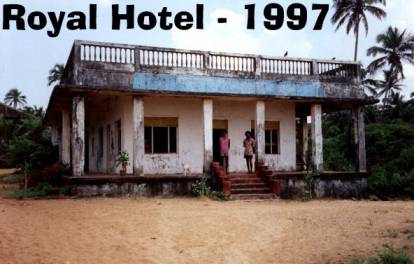
They have built a new block of rooms that are simply furnished, and each room has its own en-suite bathroom. It is still not quite up to the standards of even the two star tourist hotels, but had it been like this at the time, I would have considered it to be the height of luxury in '68. The cost of staying for a night is now 400 rupees (£6.60). Allowing for inflation it is probably a bit more expensive, but certainly good value for backpackers. The trouble is, the few backpackers that come to Goa now, probably don't even know the place exists. They let me look around and I even took photographs of my old room. I talked to them for quite a while and then they opened up the Hotel especially for me. The building has lots of cracks in the walls and supporting pillars, probably settlement because it is built on sand. Unless they start to spend some money on maintenance soon, I reckon the place will fall down within the next 10 years or so. From there, my wife and I walked up the beach to the lagoon at Baga, where there was now a collection of restaurants and souvenir shops, before heading back to our hotel.
On another day we visited Panjim. On the way we passed the ferry terminal at Betim. I was surprised to find it still going despite the two bridges that now span the mouth of the river. It is now only a passenger ferry and instead of the passengers having to wait for a taxi to eventually arrive, there are now hundreds of taxis waiting for the passengers. We didn't use the ferry, but continued on over one of the parralell bridges over the river. Typical of Indian traffic, instead of having a one way system over the bridges, traffic flows both ways on each bridge. At the side of one of the bridges I saw the rusting hulk of an old landing craft, presumably the old ferry, now beached on the riverbank and abandoned to eventually rot away. By no stretch of the immagination can modern Panjim be described as a sleepy town any longer. The taxi we caught from Calangute spent more than half an hour just looking for a parking place. There are plenty of good quality shops there and my wife bought bags full of costume jewellery at ridiculously cheap prices. She also bought some clothes in the Benneton shop for a quarter of the cost they would be in England. Goa is a long way from England the cost of getting there is not cheap. Yet despite this the cost of living is so cheap that the total cost of our two weeks winter holiday was probably less than we would have spent had we taken a summer holiday in a European resort. All in all, the Goa of 1997 was totally different to the Goa of 1968, but I hadn't really expected it to be anything else. It is still a great place to visit and I will be going back again, only this time I don't intend to leave it for so long. By the way, there is extensive rebuilding work taking place at Dabolim Airport, which should lead to a more efficient service next time I go. Well, maybe not, after all it is India and long may it stay that way. Efficiency is not anywhere near as much fun. FOOTNOTE. My wife and I visited Goa again in January 2002. This time we stayed in the Cidade de Goa Hotel in Vainguinim Beach, which is just outside Panjim to the South. We revisited Calangute to find that tourist development had gone wild in the 5 years since our last visit. The beautiful beach was now a continuous line of sunbeds along its full 5 miles from Candolim to Baga and in the area around Calangute the old Portuguese villas were no longer there and new shops and restaurants in every bit of spare land. Goa has now become a big tourist destination and it was getting bigger still. We have decided to keep Goa as a beautiful memory, but we probably won't be going back again soon. A decision that has been reinforced by the exhorbitantly expensive Indian visa costs.
|